The break-even point (BEP) is an important concept in business and financial planning. It tells a business how much it needs to sell before it starts making a profit.
At the break-even point, total revenue is equal to total costs. The business has neither a profit nor a loss.
Understanding the break-even point helps business owners decide product prices, sales targets, production levels and whether a new business idea can cover its costs.
What Is the Break-Even Point?
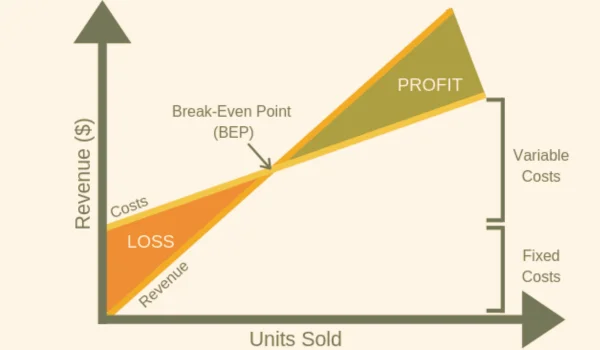
The break-even point is the level of sales at which a business recovers all its fixed and variable costs.
At this point:
Total Revenue = Total Costs
After crossing the break-even point, additional contribution from sales can generally contribute to operating profit, assuming the cost structure remains unchanged.
For example, if a business needs to sell 1,000 units to cover all its costs, 1,000 units is its break-even quantity.
Fixed Cost vs Variable Cost
To understand break-even analysis, it is important to distinguish between fixed and variable costs.
Fixed Costs
Fixed costs generally remain unchanged over a relevant range of activity, regardless of the number of units produced or sold.
Examples include:
- Office rent
- Factory rent
- Salaries of certain employees
- Insurance
- Software subscriptions
- Administrative expenses
For example, if monthly rent is ₹50,000, the rent may remain ₹50,000 whether the business sells 500 or 1,000 units, assuming the rental agreement and relevant conditions remain unchanged.
Variable Costs
Variable costs generally change with the quantity produced or sold.
Examples include:
- Raw materials
- Packaging
- Direct production costs
- Sales commissions
- Certain delivery costs
If the variable cost per unit is ₹300, selling 100 additional units would generally increase total variable costs by ₹30,000.
Break-Even Point Formula
The basic break-even formula in units is:
Break-Even Point (Units) = Fixed Costs ÷ (Selling Price per Unit − Variable Cost per Unit)
The amount inside the brackets is called contribution per unit.
Therefore:
Contribution per Unit = Selling Price − Variable Cost
And:
Break-Even Point = Fixed Costs ÷ Contribution per Unit
How to Calculate Break-Even Point
Break-even calculation can be completed in a few simple steps.
Step 1: Calculate Fixed Costs
First, determine the fixed costs for the period you are analysing.
Suppose a business has monthly fixed costs of:
₹1,00,000
Step 2: Determine Selling Price
Suppose the product is sold for:
₹500 per unit
Step 3: Determine Variable Cost
Suppose the variable cost is:
₹300 per unit
Step 4: Calculate Contribution per Unit
Contribution = ₹500 − ₹300
Contribution = ₹200 per unit
Step 5: Calculate Break-Even Quantity
Break-Even Point = ₹1,00,000 ÷ ₹200
Break-Even Point = 500 units
Therefore, the business needs to sell 500 units per month to reach its break-even point based on these assumptions.
At 500 units:
Revenue = 500 × ₹500 = ₹2,50,000
Variable Cost = 500 × ₹300 = ₹1,50,000
Fixed Cost = ₹1,00,000
Total Cost = ₹2,50,000
So:
Profit = ₹2,50,000 − ₹2,50,000 = ₹0
This is the break-even point.
Break-Even Point in Sales Value
Break-even can also be calculated in terms of sales revenue instead of units.
The formula is:
Break-Even Sales = Fixed Costs ÷ Contribution Margin Ratio
The contribution margin ratio is:
Contribution Margin Ratio = Contribution per Unit ÷ Selling Price per Unit
Using the previous example:
Contribution per unit = ₹200
Selling price = ₹500
Therefore:
Contribution Margin Ratio = ₹200 ÷ ₹500 = 40%
Now:
Break-Even Sales = ₹1,00,000 ÷ 40%
Break-Even Sales = ₹2,50,000
Therefore, the business needs monthly sales of approximately ₹2.5 lakh to break even.
Break-Even Point Example for a Small Business
Consider a small food business selling packaged products.
| Particular | Amount |
| Monthly fixed costs | ₹1,50,000 |
| Selling price per unit | ₹200 |
| Variable cost per unit | ₹120 |
| Contribution per unit | ₹80 |
| Break-even quantity | 1,875 units |
| Break-even sales | ₹3,75,000 |
Calculation:
₹1,50,000 ÷ (₹200 − ₹120) = 1,875 units
The business therefore needs to sell approximately 1,875 units per month to cover the stated costs.
If it sells fewer units, it would generally operate below the break-even level. If it sells more, it can potentially generate an operating profit, assuming other factors remain unchanged.
What Is Contribution Margin?
Contribution margin shows how much revenue remains after variable costs to contribute towards fixed costs and, after those are covered, profit.
Formula:
Contribution Margin = Sales Revenue − Variable Costs
For example:
Sales = ₹5,00,000
Variable costs = ₹3,00,000
Contribution margin:
₹5,00,000 − ₹3,00,000 = ₹2,00,000
The ₹2 lakh contribution first helps cover fixed costs. Any remaining amount after fixed costs can contribute to profit.
Break-Even Point vs Profit
The break-even point should not be confused with a profit target.
Suppose the break-even quantity is 500 units.
- Sales below 500 units → potentially a loss
- Sales at 500 units → no profit or loss
- Sales above 500 units → potentially a profit
However, actual results can differ if there are changes in pricing, costs, product mix, discounts, returns or other expenses.
Why Is Break-Even Analysis Important?
Break-even analysis can help businesses with several decisions.
- Setting Sales Targets
A business can establish a minimum sales target required to cover its costs.
- Pricing Decisions
Businesses can examine how a change in selling price affects the number of units required to break even.
- Cost Control
Reducing fixed or variable costs can reduce the break-even level, depending on the circumstances.
- Business Planning
Entrepreneurs can estimate the sales volume needed to cover operating costs before launching a product or service.
- Investment Decisions
Break-even analysis can help evaluate whether a proposed project or product has a realistic path to covering its costs.
What Happens If the Selling Price Changes?
Selling price has a direct impact on contribution per unit.
Suppose:
- Selling price = ₹500
- Variable cost = ₹300
- Fixed cost = ₹1,00,000
Break-even quantity:
₹1,00,000 ÷ ₹200 = 500 units
If the selling price increases to ₹600 while the variable cost remains ₹300:
Contribution = ₹600 − ₹300 = ₹300
New break-even quantity:
₹1,00,000 ÷ ₹300 = 333.33 units
Since businesses generally sell whole units, approximately 334 units would be required to cover the fixed cost under this simplified assumption.
This illustrates how pricing and contribution affect break-even requirements.
Limitations of Break-Even Analysis
Break-even analysis is useful, but it relies on assumptions.
Some important limitations include:
- Selling prices may change.
- Variable costs may not remain constant.
- Fixed costs can increase at higher production levels.
- Businesses may sell multiple products with different margins.
- Demand may be lower than expected.
- Discounts and returns can affect actual revenue.
- Taxes, financing costs and other expenses may need separate consideration.
Therefore, break-even analysis should be treated as a planning tool rather than a guarantee of business performance.
Break-Even Point for Multiple Products
Businesses selling several products have a more complicated calculation.
For example, a company may sell:
- Product A with a 40% contribution margin
- Product B with a 25% contribution margin
- Product C with a 50% contribution margin
The overall break-even point depends on the sales mix.
If customers start buying more of the lower-margin product, the overall contribution margin can decrease and the business may need higher sales to break even.
Frequently Asked Questions
What is the break-even point?
The break-even point is the sales level at which total revenue equals total costs, resulting in neither profit nor loss.
What is the break-even formula?
The basic formula is:
Break-Even Point in Units = Fixed Costs ÷ (Selling Price per Unit − Variable Cost per Unit)
What happens after the break-even point?
Once the break-even point is crossed, additional contribution can generally contribute to operating profit, provided prices, costs and other relevant conditions remain unchanged.
Is break-even point the same as profit?
No. At the break-even point, profit is zero. Profit begins after the business generates sufficient contribution to cover its costs.
Can break-even point be calculated for a service business?
Yes. For services, the calculation can use the price charged per service and the variable cost associated with providing that service.
Why is break-even analysis important for startups?
It helps startups estimate the sales volume or revenue needed to cover their costs and can support pricing, budgeting and business planning decisions.
Conclusion
The break-even point shows how much a business needs to sell to cover its costs. The basic calculation depends on fixed costs, selling price and variable cost per unit.
By regularly reviewing its break-even point, a business can better understand its cost structure, set realistic sales targets and assess the effect of changes in price or expenses.