A stop-loss order in crypto is a trading instruction designed to automatically trigger a sell or buy order when the cryptocurrency reaches a specified price. Traders commonly use it to manage downside risk, protect profits or automatically exit a position when the market moves against them.
For a long crypto position, a sell stop-loss is generally placed below the current market price. When the trigger price is reached, the stop order can become a market order, depending on the exchange and order type. This means the stop price is a trigger, not necessarily the final execution price.
Because cryptocurrency prices can move rapidly, understanding how stop-loss orders work is important before using them, particularly in leveraged futures trading.
What Is a Stop-Loss Order in Crypto?
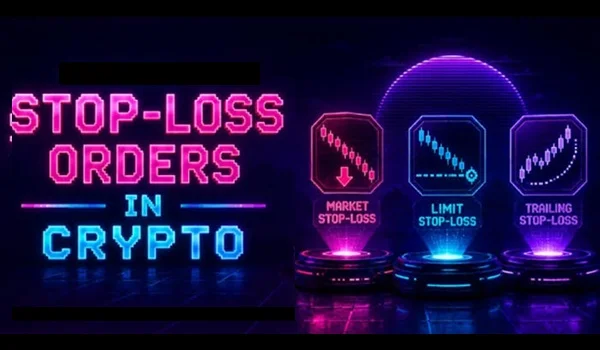
A stop-loss order is an order that becomes active when the market reaches a predetermined stop price.
For example, suppose you buy Bitcoin at ₹90 lakh and decide that you do not want the position to remain open if Bitcoin falls significantly.
You could set a sell stop-loss at:
Stop price = ₹85 lakh
If the market reaches the trigger level, the stop-loss mechanism activates according to the exchange’s rules.
With a stop-market order, the resulting order generally attempts to sell at the available market price. Therefore, you should not assume that the crypto will necessarily be sold at exactly ₹85 lakh.
How Does a Crypto Stop-Loss Work?
The process can be simplified into four steps:
- You open a crypto position.
- You select a stop price.
- The exchange monitors the relevant price or trigger condition.
- When the trigger is reached, the exchange activates the specified order.
For a simple sell stop:
Current price → Stop price reached → Order activated → Position sold
The exact trigger mechanism varies between exchanges. Some platforms may use the last traded price, mark price or another reference price for particular products, so traders should check the exchange’s rules before placing an order.
Example of a Stop-Loss Order
Suppose you buy 0.1 BTC at ₹90,00,000 per BTC.
Your total position value is:
₹90,00,000 × 0.1 = ₹9,00,000
You decide to place a stop-loss at ₹85,00,000.
If Bitcoin falls and the stop condition is triggered, the sell order becomes active.
If the market is trading around ₹84,80,000 when the order is executed, the actual selling price could be below your ₹85 lakh trigger.
This difference can occur because the stop price activates the order; it does not necessarily guarantee the execution price. Fast-moving markets can make the difference larger.
Stop Price vs Execution Price
This is one of the most important concepts to understand.
Stop Price
The stop price is the price or trigger level at which the stop order becomes active.
Execution Price
The execution price is the actual price at which the trade is filled.
They can be different.
For example:
| Detail | Price |
| Current Bitcoin price | ₹90,00,000 |
| Stop price | ₹85,00,000 |
| Market price when activated | ₹84,70,000 |
| Possible execution price | ₹84,65,000 |
These figures are illustrative.
A market-based stop order can experience slippage, especially when the market is moving quickly or available liquidity is limited.
What Is a Stop-Market Order?
A stop-market order uses a stop price as a trigger.
Once triggered, it becomes a market order.
For a long position:
Stop price reached → Market sell order → Available market price
The main advantage is that it prioritises execution after the trigger.
The main limitation is that the exact execution price is not guaranteed.
Example
Bitcoin is trading at ₹90 lakh.
You set:
Stop price = ₹86 lakh
Bitcoin suddenly falls sharply and reaches the trigger.
The stop order activates and attempts to sell at available market prices.
If the available bids are ₹85.8 lakh, ₹85.6 lakh and ₹85.3 lakh, the execution could occur around those levels rather than exactly at ₹86 lakh.
What Is a Stop-Limit Order?
A stop-limit order combines a stop trigger with a limit price.
Once the stop price is reached, the order becomes a limit order rather than a market order.
For example:
- Stop price: ₹85 lakh
- Limit price: ₹84.50 lakh
If Bitcoin reaches ₹85 lakh, the limit order becomes active.
It can then sell at ₹84.50 lakh or better, subject to the exchange’s matching rules.
The advantage is greater price control.
The disadvantage is that the order may not execute if the market falls below the limit price too quickly.
Stop-Market vs Stop-Limit
| Feature | Stop-Market | Stop-Limit |
| Trigger price | Yes | Yes |
| Limit price | No | Yes |
| Prioritises execution | Generally | No |
| Price control | Lower | Higher |
| Slippage risk | Higher | More controlled |
| Risk of no execution | Lower after trigger, subject to liquidity | Higher |
| Useful for | Exiting quickly after trigger | Controlling minimum/maximum execution price |
The basic trade-off is:
Stop-market = more emphasis on execution
Stop-limit = more emphasis on price control
A stop-limit order can fail to execute if the market moves beyond the specified limit.
Stop-Loss for Long Crypto Positions
For a long position, you own or are exposed to the cryptocurrency with the expectation that its value will rise.
A sell stop-loss is generally placed below the current price.
Example:
Entry: ₹90 lakh
Stop-loss: ₹85 lakh
If the market falls to the trigger level, the order activates.
The purpose is to automatically exit if the market moves against the position.
Stop-Loss for Short Crypto Positions
A stop-loss can also be used for a short position.
A short position generally benefits when the asset’s price falls.
Therefore, a buy stop can be placed above the current market price.
Example:
Short entry: ₹90 lakh
Stop-loss: ₹95 lakh
If Bitcoin rises to the trigger level, the buy order can activate to close the short position.
Investor.gov describes the same basic principle for stop orders: a sell stop is generally below the current market price for a position being sold, while a buy stop is generally above the current market price for a short position.
Stop-Loss vs Take-Profit
These two orders are often used together.
Stop-Loss
Designed to automatically exit when the market moves against the position.
Take-Profit
Designed to automatically exit when a predetermined profit target is reached.
For example:
Crypto entry: ₹90 lakh
Stop-loss: ₹85 lakh
Take-profit: ₹98 lakh
The stop-loss addresses downside risk, while the take-profit addresses the planned exit on the upside.
Some derivatives platforms offer bracket or TP/SL orders that combine these instructions. For example, Coinbase’s derivatives documentation describes bracket orders that can set both take-profit and stop-loss targets for an existing position.
What Is a Trailing Stop-Loss?
A trailing stop adjusts the stop level as the market moves in your favour.
Suppose you buy Bitcoin at ₹90 lakh and set a hypothetical 5% trailing stop.
If Bitcoin rises to ₹95 lakh, the trailing level moves upward according to the platform’s rules.
If Bitcoin subsequently falls by the specified trailing amount, the stop can trigger.
The key difference from a fixed stop is that the stop level can move with favourable price movements but does not normally move back in the opposite direction.
Trailing-stop functionality and calculation methods vary between exchanges, so check the platform’s specific rules.
What Is Slippage in a Stop-Loss?
Slippage occurs when the actual execution price differs from the expected trigger or displayed price.
Suppose:
Stop price = ₹80 lakh
A sudden market decline causes Bitcoin to move rapidly from ₹80 lakh to ₹77 lakh.
A stop-market order could potentially execute around available prices near ₹77 lakh rather than exactly at ₹80 lakh.
This is one reason a stop-loss should not be viewed as a guaranteed maximum-loss price. Investor.gov similarly warns that a stop price is a trigger and not a guaranteed execution price in a fast-moving market.
Can a Stop-Loss Guarantee Your Maximum Loss?
No.
A stop-loss can help automate an exit, but it cannot guarantee that the final loss will be limited to the difference between the entry price and stop price.
Reasons include:
- Sudden price movements
- Low liquidity
- Gaps or rapid market moves
- Slippage
- Exchange-specific trigger rules
- Network or platform disruptions
- Partial execution
A stop-limit order can provide greater price control, but it introduces the possibility that the order will not execute at all if the market moves beyond the limit.
Stop-Loss in Crypto Futures
Stop-loss orders become particularly important in crypto futures trading because leverage can increase the size of both gains and losses.
Suppose you open a leveraged Bitcoin futures position.
A relatively small movement in Bitcoin can have a much larger effect on your margin.
A stop-loss can be used to automatically attempt to close the position if the market reaches a specified level.
However, a stop-loss does not eliminate liquidation risk.
If the market moves extremely quickly and the position reaches its liquidation conditions before the stop order can execute, the exchange’s liquidation mechanism may take precedence according to its rules.
Traders should therefore understand:
- Initial margin
- Maintenance margin
- Leverage
- Liquidation price
- Mark price
- Funding costs
- Stop trigger price
before relying on a stop-loss for a leveraged position.
Stop-Loss vs Liquidation
These concepts are different.
| Feature | Stop-Loss | Liquidation |
| Purpose | Planned risk-management exit | Forced position closure |
| Who initiates it? | Trader’s order | Exchange/system under applicable rules |
| Trigger | Trader-selected condition | Margin/liquidation conditions |
| Applies to spot? | Can | Generally no |
| Applies to futures? | Yes, where supported | Yes |
| Trader controls level? | Generally yes | No |
| Guaranteed execution price? | Not necessarily | Depends on liquidation mechanism |
A stop-loss is a planned exit instruction.
Liquidation is a forced closure mechanism associated with leveraged positions.
How to Set a Crypto Stop-Loss
There is no single stop-loss percentage that suits every cryptocurrency or trading strategy.
Instead, traders can consider the following factors.
- Position Size
A larger position creates greater financial exposure.
- Market Volatility
Highly volatile crypto assets can move through a tight stop during normal price fluctuations.
- Support and Resistance
Some traders place stops around levels that would invalidate their trading thesis rather than choosing an arbitrary percentage.
- Risk Per Trade
Decide beforehand how much capital you are prepared to put at risk.
- Liquidity
Thin markets can have larger spreads and greater slippage.
- Leverage
Higher leverage can make small market movements more significant relative to your margin.
Stop-Loss Percentage Example
Suppose you buy crypto at:
₹1,00,000
You choose a hypothetical 8% stop.
Calculation:
Stop-loss = ₹1,00,000 × (1 − 8%)
Stop-loss = ₹92,000
This is only a mathematical example. The appropriate level depends on the trading strategy, volatility and position size.
Common Stop-Loss Mistakes
Setting the Stop Too Close
A highly volatile asset can trigger a tight stop during a temporary price movement.
Treating the Stop Price as a Guaranteed Exit Price
A stop-market order can execute at a different price because of slippage.
Using Excessive Leverage
A stop-loss does not remove the risks associated with leveraged trading.
Ignoring Liquidity
A thin order book can make execution more difficult.
Forgetting Open Orders
After manually closing a position, traders should check whether associated stop orders remain active and need to be cancelled.
Not Checking Trigger Rules
Different exchanges can use different reference prices and order mechanics.
Is a Stop-Loss Always Necessary in Crypto?
Not necessarily.
The decision depends on the trading strategy, asset, position size, time horizon and risk-management approach.
A long-term investor may use a different risk-management approach from an active futures trader.
The important point is to understand exactly what the selected order type does before using it.
Stop-Loss Order in Crypto: Key Points
- A stop-loss is an automated trigger used to exit or manage a crypto position.
- A sell stop is commonly used below the current price for a long position.
- A buy stop can be used above the current price to manage a short position.
- A stop-market order becomes a market order after triggering.
- A stop-limit order becomes a limit order after triggering.
- A stop price is not necessarily the final execution price.
- Slippage can occur during rapid market movements.
- A stop-limit order may not execute if the market moves beyond its limit.
- Trailing stops can adjust as the market moves favourably.
- Stop-loss orders do not eliminate liquidation risk in leveraged futures.
- Exact order types and trigger rules vary between crypto exchanges.
Crypto Stop-Loss and Tax in India
A stop-loss order itself is an order instruction, not a separate tax category.
If the order results in a transfer of a Virtual Digital Asset (VDA), the resulting transaction may have tax implications.
The Income Tax Department states that income from transfer of VDAs is taxed at 30% under Section 115BBH, along with applicable surcharge and 4% cess. The department’s current ITR guidance also provides for transaction-wise reporting in Schedule VDA.
The current Schedule VDA requires details such as acquisition date, transfer date, cost of acquisition, consideration received and income from the transfer.
Therefore, traders should maintain records of:
- Date and time of trade
- Asset sold
- Quantity
- Acquisition cost
- Sale/transfer value
- Exchange fees
- Transaction records
- Relevant order and execution details
For leveraged derivatives, the tax treatment can depend on the nature of the transaction and applicable tax rules, so traders should not automatically assume that every futures transaction receives exactly the same treatment as a spot VDA transfer.
Frequently Asked Questions
What is a stop-loss order in crypto?
It is an order designed to trigger an exit when the crypto reaches a specified price or trigger condition.
Does a stop-loss sell at the exact stop price?
Not necessarily. With a stop-market order, the stop price triggers the order, while the actual execution occurs at available market prices.
What is the difference between stop-market and stop-limit?
A stop-market order generally becomes a market order after triggering, while a stop-limit order becomes a limit order. Stop-limit provides more price control but may not execute.
Can a stop-loss prevent liquidation?
Not always. In leveraged futures, extreme price movements can cause liquidation according to the exchange’s rules before a stop order successfully closes the position.
Can a stop-loss be used for short crypto trades?
Yes. A buy stop can be used to close a short position if the market rises to the selected trigger level.
What is a trailing stop-loss?
It is a stop order whose trigger level adjusts as the market moves in a favourable direction, according to the exchange’s trailing-stop rules.
Can a stop-loss order fail?
A stop-market order can face execution problems during extreme market conditions or insufficient liquidity. A stop-limit order can remain unfilled if the market moves beyond its limit price.
Conclusion
A stop-loss order in crypto is a tool for automating a potential exit when the market reaches a predetermined trigger. It can help traders avoid relying entirely on manual monitoring, but it does not guarantee a particular selling or buying price.
The key distinction is between triggering an order and executing a trade. A stop-market order generally prioritises execution after the trigger but can experience slippage. A stop-limit order provides greater price control but can remain unfilled if the market moves too quickly.
Before using a stop-loss, crypto traders should understand the exchange’s trigger rules, liquidity, fees, order type, leverage and liquidation mechanism. Keeping accurate transaction records is also important for Indian VDA tax reporting.