A cheque bounce can become a legal matter when a cheque issued towards a legally enforceable debt or liability is returned unpaid and the requirements of Section 138 of the Negotiable Instruments Act, 1881 are satisfied.
The process does not begin with an immediate court case. There is a specific sequence involving cheque dishonour, a bank return memo, a statutory demand notice, a 15-day payment opportunity and, if payment is still not made, a complaint before the appropriate court. The Supreme Court has emphasised that compliance with these statutory steps is important before prosecution can proceed.
What Happens When a Cheque Bounces?
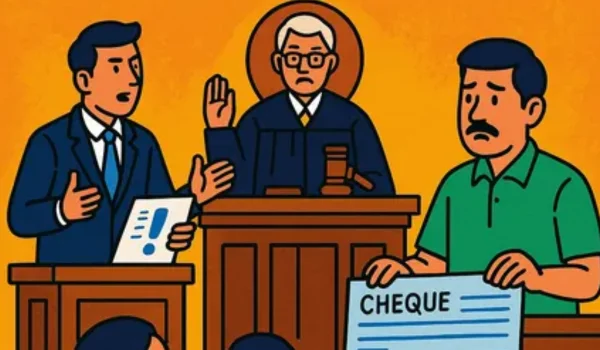
The usual sequence is:
Cheque presented → Cheque dishonoured → Bank issues return memo → Legal notice sent → 15-day payment period → Complaint filed if payment is not made → Court proceedings → Settlement or judgment
A cheque being returned unpaid does not automatically mean that the drawer is guilty of an offence. The conditions prescribed under Section 138 have to be satisfied.
Step 1: The Cheque Is Presented to the Bank
The payee deposits or presents the cheque for payment.
For banking purposes, cheques are generally subject to a three-month validity period from the date of the instrument under RBI directions. Therefore, a payee should not wait indefinitely before presenting a cheque.
If the cheque is presented within its applicable validity period and the bank honours it, there is normally no cheque-bounce case.
If the bank returns it unpaid, the next steps may follow.
Step 2: The Bank Returns the Cheque Unpaid
The bank issues a cheque return memo stating the reason for dishonour.
Common reasons may include:
- Insufficient funds
- Amount exceeding the arrangement with the bank
- Account-related problems
- Stop-payment instructions
- Signature or technical issues
- Other banking reasons
Whether a particular reason can support a Section 138 prosecution depends on the circumstances and the statutory requirements.
The return memo should be preserved because it is an important document in a potential dispute.
Step 3: The Payee Checks Whether Section 138 Applies
Before sending a notice, the payee should establish that the cheque relates to a legally enforceable debt or other liability.
For example, the underlying transaction could involve:
- A loan
- Business dues
- Payment for goods
- Payment for services
- Repayment of an outstanding amount
- Other legally enforceable financial liability
The Supreme Court has explained that Section 138 is connected to a legally enforceable debt or liability.
This is important because a returned cheque by itself does not establish every ingredient of a Section 138 offence.
Step 4: A Statutory Demand Notice Is Sent
After receiving information from the bank about dishonour, the payee or holder in due course must generally send a written demand notice within 30 days.
The notice demands payment of the cheque amount.
It generally contains details such as:
| Particular | Details |
| Drawer | Person who issued the cheque |
| Payee | Person to whom payment was due |
| Cheque number | Number printed on the cheque |
| Cheque date | Date mentioned on cheque |
| Cheque amount | Amount payable |
| Bank | Drawee/presenting bank details |
| Dishonour date | Date of return |
| Return reason | Reason stated in bank memo |
| Underlying liability | Debt or liability for which cheque was issued |
| Demand | Payment of cheque amount |
The 30-day period is important. Failure to follow the statutory requirements can affect the ability to prosecute the cheque dishonour.
Step 5: The Drawer Gets 15 Days to Pay
Once the drawer receives the statutory demand notice, the drawer gets 15 days to make payment.
This is a statutory opportunity to avoid prosecution by making the required payment.
The Supreme Court has explained that the offence contemplated by Section 138 arises only after the drawer fails to make payment within the prescribed 15-day period following receipt of the demand notice.
What if the drawer pays?
If the required payment is made within the statutory period, a Section 138 prosecution based on that default ordinarily does not arise.
The parties should nevertheless keep written proof of the payment and settlement.
What if the drawer does not pay?
If payment is not made within the 15-day period, the payee may proceed with a Section 138 complaint, subject to the applicable limitation and other legal requirements.
Step 6: A Cheque Bounce Complaint Is Filed
If the drawer does not pay, the payee can file a written complaint under Section 138 read with Section 142 of the Negotiable Instruments Act.
Section 142 provides that the complaint must generally be filed within one month from the date on which the cause of action arises. The court can take a delayed complaint if the complainant satisfies it that there was sufficient cause for the delay.
The complaint is filed before the court having the legally applicable territorial jurisdiction.
Step 7: The Court Examines the Complaint
The court considers the complaint and supporting material.
Documents may include:
- Original cheque
- Bank return memo
- Copy of statutory notice
- Proof of sending the notice
- Proof of delivery, where available
- Agreement or invoice
- Loan documents
- Account statements
- Payment records
- Other evidence relating to the underlying liability
The exact documents required depend on the facts of the case.
Step 8: Court Proceedings Begin
A Section 138 case is a criminal proceeding, although the provision also has a significant compensatory objective.
The Supreme Court has described Section 138 as having a hybrid character involving criminal consequences and the recovery/compensation aspect associated with a dishonoured cheque.
The court may proceed through stages such as:
- Filing of complaint
- Examination of the complaint and documents
- Issuance of process/summons where appropriate
- Appearance of the accused
- Plea and trial proceedings
- Evidence
- Cross-examination, where applicable
- Defence
- Final arguments
- Judgment
The exact procedure can vary according to the case and applicable procedural law.
What Happens After the Accused Appears?
The accused gets an opportunity to contest the allegations.
The complainant must establish the ingredients necessary for the offence, while statutory presumptions under the Negotiable Instruments Act can become important.
Section 139 presumption
Section 139 provides a presumption that the holder received the cheque for discharge, wholly or partly, of a debt or other liability, unless the contrary is proved.
The Supreme Court has clarified that this presumption is rebuttable. The accused can rely on evidence and circumstances to establish a probable defence.
Therefore, a cheque-bounce case is not automatically decided against the drawer merely because a cheque was dishonoured.
Can the Drawer Defend a Cheque Bounce Case?
Yes.
Depending on the facts, the defence may raise issues such as:
- There was no legally enforceable debt
- The alleged liability had already been paid
- The cheque was not issued for the claimed liability
- The statutory notice requirements were not fulfilled
- The complaint was filed beyond the applicable limitation
- The cheque was materially disputed
- The underlying transaction was different from what the complainant alleges
- Other evidence rebuts the statutory presumption
The strength and relevance of a defence depend on the evidence in the particular case.
What Happens if the Case Is Settled?
A cheque-bounce dispute can be settled in appropriate circumstances.
For example, the drawer and complainant may agree on:
- Full cheque amount
- Interest
- Litigation expenses
- A mutually agreed settlement amount
- Payment in instalments
A settlement should be properly documented. Merely making a verbal promise to pay later may not resolve the pending legal proceedings.
Can the Court Order Interim Compensation?
Yes.
Section 143A allows the court, in specified circumstances, to order the drawer to pay interim compensation of up to 20% of the cheque amount.
The provision applies in circumstances specified by the statute, including certain cases where the accused pleads not guilty or after framing of charge, depending on the type of case.
Therefore, interim compensation is not an automatic 20% penalty in every cheque-bounce case.
What Happens if the Accused Is Convicted?
If the court finds the accused guilty under Section 138, the statutory punishment can include:
- Imprisonment up to two years
- Fine up to twice the cheque amount
- Both imprisonment and fine
The maximum punishment does not mean that every conviction results in two years’ imprisonment or a fine equal to twice the cheque amount.
The court determines the appropriate sentence and other relief based on the law and facts of the case.
What Happens if the Accused Is Acquitted?
If the court finds that the prosecution has not established the offence, or the accused successfully rebuts the case as required, the accused may be acquitted.
The legal consequences of an acquittal depend on the judgment and circumstances of the case.
What Happens to the Money Owed?
A Section 138 case and the underlying monetary liability are related but should not be treated as exactly the same thing.
The Supreme Court has noted the compensatory character of Section 138, but the availability of other recovery remedies depends on the underlying transaction and applicable law.
A creditor should therefore consider the appropriate legal remedy based on the nature of the debt, documents and limitation position.
What Happens if the Cheque Was a Security Cheque?
Calling a cheque a “security cheque” does not automatically end a Section 138 case.
The important questions can include:
- Why was the cheque issued?
- Did a legally enforceable liability exist?
- What amount was actually due?
- When was the cheque presented?
- What did the parties agree?
- What evidence supports each side?
The facts surrounding the underlying transaction therefore matter.
What Happens if the Drawer Stops Payment?
A stop-payment instruction does not automatically prevent Section 138 proceedings.
The court may examine the underlying debt or liability and other statutory requirements.
Therefore, the drawer should not assume that instructing the bank to stop payment automatically removes all legal consequences.
What Documents Should the Payee Keep?
A person dealing with a bounced cheque should preserve:
- Original cheque
- Bank return memo
- Bank statement
- Invoice or agreement
- Loan documents
- Payment records
- Statutory notice
- Postal receipt
- Tracking details
- Proof of delivery
- Emails or messages concerning the transaction
- Settlement communications
Good documentation can become important if the transaction is later disputed.
Simple Example of a Cheque Bounce Case
Suppose A owes B ₹3 lakh and gives B a cheque for ₹3 lakh.
The sequence could look like this:
- B deposits the cheque.
- The bank returns it unpaid because of insufficient funds.
- B receives the bank’s dishonour information and return memo.
- B sends the statutory demand notice within the prescribed 30-day period.
- A receives the notice.
- A gets 15 days to make the required payment.
- If A pays within that period, the Section 138 prosecution does not arise from that default.
- If A does not pay, B can file a complaint subject to Section 142 and the applicable limitation and jurisdiction requirements.
- The court then conducts the proceedings.
- The matter may ultimately be settled, or the court may acquit or convict the accused depending on the evidence and applicable law.
Cheque Bounce Case Timeline
| Stage | What happens |
| Cheque issued | Drawer gives cheque towards liability |
| Presentation | Payee deposits/presents cheque |
| Dishonour | Bank returns cheque unpaid |
| Return memo | Bank records reason for dishonour |
| Legal notice | Generally sent within 30 days of receiving dishonour information |
| Payment period | Drawer gets 15 days after receipt of notice |
| No payment | Cause of action arises after statutory period |
| Complaint | Generally filed within one month of cause of action |
| Court process | Court considers complaint and proceeds according to law |
| Final outcome | Settlement, acquittal or conviction, depending on case |
The Supreme Court has confirmed the importance of the 30-day notice requirement and the one-month complaint period under Section 142, while also recognising that a subsequent valid presentation and notice can, in appropriate circumstances, create a fresh cause of action.
Common Mistakes in Cheque Bounce Cases
Missing the notice deadline
The payee should carefully calculate the 30-day period after receiving information about dishonour.
Waiting too long to present the cheque
A cheque should be presented within its applicable banking validity period.
Not preserving the return memo
The return memo records the bank’s reason for dishonour and can be important evidence.
Sending an incomplete notice
The statutory demand notice should clearly identify the cheque and demand the required payment.
Ignoring the underlying debt
Section 138 is connected to a legally enforceable debt or liability. Documentation of the underlying transaction is therefore important.
Filing in the wrong court
Cheque-bounce jurisdiction is governed by specific statutory rules. The appropriate court should be verified before filing.
Assuming a cheque bounce automatically means conviction
Dishonour alone does not establish every ingredient of a Section 138 offence.
Frequently Asked Questions
Is a cheque bounce immediately a criminal case?
No. The statutory process must be followed. After dishonour, the payee generally has to issue the required notice and give the drawer 15 days to make payment before the cause of action for prosecution arises.
How long does a cheque bounce case take?
There is no single fixed duration. The time depends on factors such as court workload, service of summons, appearances, evidence, adjournments, settlement discussions and appeals.
What happens after a cheque bounce legal notice?
The drawer gets 15 days from receipt of the statutory demand notice to make the required payment. If payment is not made, the payee may proceed with a complaint subject to the applicable legal requirements.
What happens if I ignore a cheque bounce notice?
Ignoring the notice does not automatically make the allegations true, but it also does not stop the statutory process. If the required payment is not made within the 15-day period, the payee may initiate proceedings subject to the law.
Can a cheque bounce case be settled?
Yes. Settlement is possible in appropriate cases. The parties should properly document the settlement and take the necessary legal steps regarding the pending case.
Can I be arrested for a cheque bounce case?
A cheque-bounce complaint is a criminal proceeding, but the mere fact that a cheque has bounced does not mean that a person is automatically arrested. The procedural position depends on the stage of the case and the orders of the court.
What is the maximum punishment for cheque bounce?
Section 138 provides for imprisonment up to two years, or fine up to twice the cheque amount, or both, if the offence is established.
What is the 30-day rule in cheque bounce cases?
The payee or holder in due course generally has 30 days from receiving information about the dishonour from the bank to issue the statutory written demand notice.
What is the 15-day rule?
The drawer gets 15 days from receipt of the statutory demand notice to make payment. Failure to pay within that period can give rise to the cause of action for a Section 138 complaint, subject to the other requirements of law.
Conclusion
A cheque bounce case does not normally go straight from bank dishonour to court. Section 138 establishes a sequence designed to give the drawer an opportunity to make payment before criminal proceedings are initiated.
The basic process is:
Cheque dishonoured → return memo → statutory notice within 30 days → 15-day payment opportunity → complaint if payment is not made → court proceedings → settlement, acquittal or conviction depending on the case.
The most important practical points are to preserve the cheque and return memo, document the underlying debt, comply with the notice and limitation periods, and verify the correct court before filing.
Because procedural errors can affect a Section 138 case, parties dealing with a substantial amount or a disputed transaction should obtain advice from a qualified legal professional.