Applying for a home loan involves more than submitting an application form. Banks and housing finance companies generally verify the applicant’s identity, address, income, repayment capacity and the legal status of the property before approving the loan.
The exact home loan documents required can vary depending on the lender, applicant profile, loan amount, type of property and whether the applicant is salaried or self-employed. RBI guidance says lenders generally seek identity and residence proof, income-related documents and legal documents relating to the house being purchased.
Quick List of Home Loan Documents
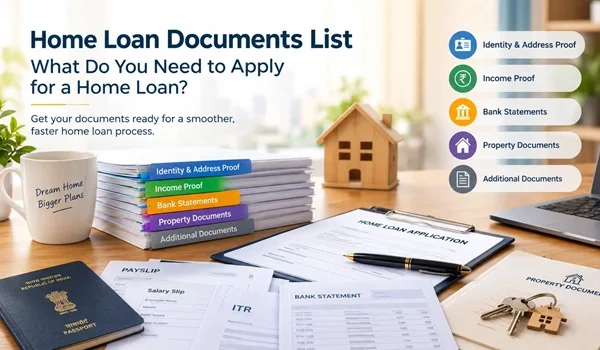
| Document Category | Common Documents |
| Identity proof | PAN, Passport, Driving Licence, Voter ID, etc. |
| Address proof | Aadhaar, Passport, Driving Licence, Voter ID, etc. |
| Income proof – Salaried | Salary slips, Form 16, bank statements |
| Income proof – Self-employed | ITRs, financial statements, bank statements |
| Employment/business proof | Employment details or business/professional documents |
| Property documents | Sale agreement, title documents, approved plan, etc. |
| Bank documents | Recent bank statements |
| Photographs | Passport-size photographs |
| Loan application | Completed and signed application form |
| Other documents | Existing loan details, co-applicant documents, additional documents if requested |
The lender may ask for additional documents depending on the case. For example, HDFC Bank’s current home-loan documentation list includes KYC, income and property documents for the applicant and co-applicants.
- Identity Proof
The first requirement is generally proof of identity. Commonly accepted documents can include:
- PAN Card
- Passport
- Driving Licence
- Voter ID
- Other officially valid documents accepted by the lender
A PAN card or Form 60 may also be required as part of the lender’s documentation process. Current lender documentation lists PAN or Form 60 along with officially valid identity/address documents.
- Address Proof
You may need to provide proof of your current residential address.
Common documents include:
- Aadhaar
- Passport
- Driving Licence
- Voter ID
- Other officially valid documents accepted by the lender
The address on the document may be checked against the information provided in the loan application.
- Income Documents for Salaried Applicants
Salaried applicants generally need documents that demonstrate regular income and employment.
Common requirements include:
- Latest salary slips
- Form 16
- Recent bank statements showing salary credits
- Employment or employer details, where required
- Income-tax documents, if requested
RBI’s consumer guidance specifically mentions the latest salary slip and recent bank statements among documents that banks generally seek for housing loans.
The lender may request more salary slips or longer bank-statement history depending on its internal policy and the applicant’s profile.
- Income Documents for Self-Employed Applicants
Self-employed individuals, business owners and professionals may have to provide more extensive financial information because their income may not come through a fixed monthly salary.
Typical documents can include:
- Income Tax Returns (ITRs)
- Profit and loss statements
- Balance sheets
- Bank statements
- Business or professional proof
- GST-related documents, where applicable
- Proof of business continuity, where required
The exact requirement depends on whether the applicant operates a proprietorship, partnership, company or professional practice.
- Bank Statements
Recent bank statements help the lender understand income credits, existing EMIs, regular expenses and overall financial activity.
A lender may ask for bank statements for several months. RBI guidance refers to the last six months’ bank statements in the context of documents generally sought for housing-loan applications.
The account statements should normally be clear and complete, with the applicant’s name and transaction history visible.
- Property Documents
Property-related documents are an important part of a home-loan application because the lender needs to assess the property being financed and its legal status.
Depending on the type of property and transaction, documents may include:
- Sale agreement or agreement to sell
- Sale deed or title deed
- Previous title documents
- Approved building plan
- Property tax receipts
- Encumbrance-related documents, where applicable
- Completion or occupancy certificate, where applicable
- Possession letter, where applicable
- Builder or developer documents for under-construction projects
- NOC or other approvals, where required
RBI guidance states that lenders generally require legal documents relating to the house being purchased. It also notes that the property title should be free from adverse encumbrances such as an existing mortgage or litigation affecting the title.
For certain constructed properties, RBI’s housing-finance directions also address compliance with sanctioned plans and building bye-laws and require relevant verification before disbursement.
- Documents for a Co-Applicant
If you are applying for a joint home loan, the bank generally requires documentation from each applicant.
This can include:
- PAN
- Identity proof
- Address proof
- Income documents
- Bank statements
- Photographs
- Employment or business documents, as applicable
The exact documents depend on the co-applicant’s income source and role in the loan.
- Documents for Existing Loans
If you already have loans or other financial obligations, the lender may ask for information such as:
- Existing loan statements
- Repayment schedule
- Outstanding balance
- EMI details
- Loan sanction documents, where required
This helps the lender assess your existing repayment commitments while evaluating the proposed home loan.
- Photographs and Loan Application Form
Most lenders require a completed and signed home-loan application form along with photographs.
The application normally contains details such as:
- Personal information
- Employment/business details
- Income
- Existing liabilities
- Property details
- Loan amount requested
- Co-applicant details
The lender may also require declarations, authorisations and other forms during processing.
Home Loan Documents for Salaried vs Self-Employed Applicants
| Requirement | Salaried Applicant | Self-Employed Applicant |
| PAN | Usually required | Usually required |
| Identity/address proof | Required | Required |
| Salary slips | Generally required | Not applicable |
| Form 16 | Commonly required | May not apply |
| ITR | May be requested | Commonly required |
| Bank statements | Required | Required |
| Financial statements | Usually not required | May be required |
| Business proof | Not applicable | Generally required |
| Property documents | Required | Required |
| Photographs | Required | Required |
| Existing loan details | If applicable | If applicable |
Documents Required for a Home Loan Based on Property Type
The property documents can differ depending on what you are financing.
Ready-to-Move or Resale Property
You may need:
- Sale agreement
- Title documents
- Previous ownership documents
- Approved building plan
- Property tax records
- Completion/occupancy documents, where applicable
- Other legal documents requested by the lender
Under-Construction Property
Documents can include:
- Builder-buyer agreement
- Builder’s title documents
- Approved project plans
- Payment schedule
- Construction-related approvals
- Demand letters issued by the builder
The lender may independently conduct legal and technical checks before approving the property.
Home Construction Loan
For construction on your own land, the lender may request documents such as:
- Land title documents
- Approved building plan
- Construction estimate
- Local authority approvals
- Land-related records
- Architect/engineer documents, where applicable
Why Do Banks Ask for So Many Documents?
Home loans are long-term secured loans, so lenders need to verify both the borrower and the property.
The documentation generally helps the lender assess:
- Identity – whether the applicant is correctly identified.
- Address – where the applicant resides.
- Income – whether there is sufficient and stable income.
- Repayment capacity – whether the proposed EMI is manageable alongside existing obligations.
- Property ownership – whether the seller has valid rights over the property.
- Legal status – whether there are title issues, encumbrances or other legal concerns.
- Property compliance – whether relevant approvals and sanctioned plans are in place.
The property generally serves as security for the housing loan, commonly through a mortgage or deposit of title deeds.
Tips for Preparing Home Loan Documents
Before applying, keep the following points in mind:
- Keep your PAN and KYC documents updated.
- Make sure your name is consistent across important documents.
- Keep recent bank statements readily available.
- Salaried applicants should keep salary slips and Form 16 accessible.
- Self-employed applicants should organise ITRs and financial statements.
- Collect the property’s complete legal document chain before submitting the application.
- Keep documents of all co-applicants ready.
- Provide clear copies or digital scans where permitted.
- Check whether the lender requires self-attested copies.
- Ask the lender for its latest document checklist because requirements can vary.
Can a Home Loan Be Rejected Because of Missing Documents?
Missing documents can delay processing or prevent the lender from completing its verification. However, missing paperwork does not necessarily mean that the loan will automatically be rejected.
The lender may ask the applicant to provide additional information or documents. Final approval also depends on factors such as income, credit profile, existing obligations, property valuation and legal/technical verification.
Frequently Asked Questions
What are the basic documents required for a home loan?
The basic requirements generally include an application form, PAN/KYC documents, address proof, income proof, bank statements, photographs and property documents.
Are bank statements required for a home loan?
Yes, lenders commonly request recent bank statements to assess income, financial transactions and existing repayment obligations. The exact period varies by lender and applicant profile. RBI consumer guidance mentions six months’ bank statements among documents generally sought for housing loans.
What documents are required for a home loan for salaried employees?
Salaried applicants commonly need PAN/KYC documents, salary slips, Form 16 or other income documents, bank statements, photographs and property documents.
What documents are required for a home loan for self-employed people?
Self-employed applicants generally need PAN/KYC documents, ITRs, bank statements, financial statements and business or professional documents, in addition to the property documents.
Are property documents necessary for a home loan?
Yes. Property documents are an important part of the lender’s legal and technical assessment. The exact documents depend on whether the property is new, resale, under construction or being constructed by the borrower.
Do all banks require the same home loan documents?
No. Basic documentation is similar, but individual lenders can ask for additional documents depending on the applicant, property, loan amount and internal credit policies. Current lender checklists also state that requirements can vary based on applicant profile and other factors.
Conclusion
The documents required for a home loan generally fall into four major categories: KYC documents, income and financial documents, property documents, and loan/application documents. Salaried applicants usually provide salary-related proof, while self-employed applicants may need ITRs, financial statements and business-related documents.
Preparing the documents in advance can make the application and verification process smoother. Since requirements differ between lenders and property types, it is advisable to obtain the lender’s latest checklist before submitting the application.