Gross profit and net profit are two important measures used to understand a business’s financial performance. Although both are calculated from revenue, they are calculated at different stages of the income statement and provide different information about a company’s profitability.
Gross profit primarily shows how much a business earns after covering the direct costs associated with producing or purchasing the goods and services it sells. Net profit goes further by accounting for operating expenses, finance costs, taxes and other applicable expenses and income.
For example, a business may generate ₹1 crore in revenue, have a gross profit of ₹40 lakh and end the year with a net profit of only ₹10 lakh. The difference represents costs incurred between the gross profit and final profit.
Understanding gross profit vs net profit is useful for business owners, entrepreneurs, investors, managers and anyone learning how to read financial statements.
What Is Gross Profit?
Gross profit is the amount remaining after deducting the cost of goods sold (COGS) or cost of sales from revenue.
The basic formula is:
Gross Profit = Revenue − Cost of Goods Sold
For a trading business, COGS may include the purchase cost of products sold. For a manufacturing business, it can include relevant direct production costs.
For example:
- Revenue: ₹50 lakh
- Cost of goods sold: ₹30 lakh
Therefore:
Gross Profit = ₹50 lakh − ₹30 lakh = ₹20 lakh
The business has generated ₹20 lakh in gross profit before considering other operating and non-operating expenses.
What Does Gross Profit Tell You?
Gross profit provides an indication of how much a business retains from its sales after covering the direct costs associated with those sales.
It can help businesses analyse:
- Product pricing
- Production efficiency
- Procurement costs
- Direct labour costs
- Cost of materials
- Product-level profitability
- Changes in gross margins
A falling gross profit margin may require management to examine whether production costs have increased, selling prices have changed or the company’s product mix has shifted.
What Is Net Profit?
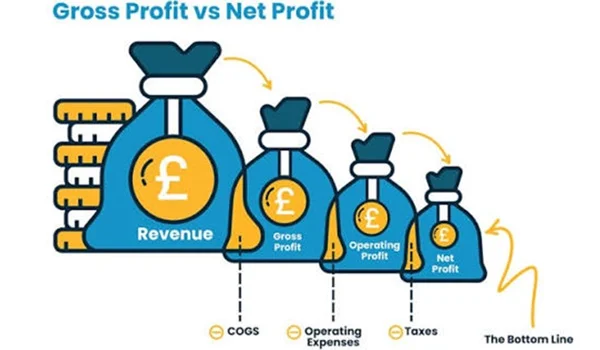
Net profit is the amount remaining after accounting for the relevant expenses, finance costs, taxes and other applicable items.
A simplified formula is:
Net Profit = Total Income − Total Expenses
Suppose a company has:
- Revenue: ₹50 lakh
- Cost of goods sold: ₹30 lakh
- Operating expenses: ₹12 lakh
- Finance costs and taxes: ₹3 lakh
Its simplified calculation would be:
Gross Profit = ₹50 lakh − ₹30 lakh = ₹20 lakh
Net Profit = ₹20 lakh − ₹12 lakh − ₹3 lakh = ₹5 lakh
Therefore, the business has ₹20 lakh of gross profit but only ₹5 lakh of net profit.
The exact calculation and presentation can vary depending on the applicable accounting standards and the nature of the business.
Gross Profit vs Net Profit: Key Differences
| Basis | Gross Profit | Net Profit |
| Meaning | Profit after deducting direct costs from revenue | Profit remaining after relevant expenses and other applicable items |
| Formula | Revenue − COGS/cost of sales | Income − applicable expenses |
| Considers operating expenses? | Generally no | Yes |
| Considers finance costs? | Generally no | Yes, where applicable |
| Considers tax? | No | Yes, where applicable |
| Measures | Profitability of goods/services after direct costs | Overall profitability |
| Position in calculation | Earlier stage | Later stage |
| Also associated with | Gross margin | Net margin |
The easiest way to remember the difference is:
Gross profit looks at the profitability after direct costs, while net profit considers the broader costs of running the business.
Gross Profit Formula
The basic formula is:
Gross Profit = Revenue − Cost of Goods Sold
For example, a retailer generates ₹80 lakh in sales and purchases the products sold for ₹50 lakh.
Gross Profit = ₹80 lakh − ₹50 lakh = ₹30 lakh
The retailer’s gross profit is ₹30 lakh.
However, this does not mean that ₹30 lakh is the final earnings of the business. The retailer still has to pay expenses such as salaries, rent, electricity, advertising, technology costs, interest and taxes.
Net Profit Formula
A simplified formula is:
Net Profit = Revenue − Total Expenses
Alternatively, when starting from gross profit:
Net Profit = Gross Profit − Operating Expenses − Finance Costs − Taxes ± Other Applicable Items
The exact calculation depends on the financial statement and applicable accounting framework.
For example:
- Revenue = ₹80 lakh
- COGS = ₹50 lakh
- Gross profit = ₹30 lakh
- Operating expenses = ₹15 lakh
- Finance costs = ₹3 lakh
- Tax and other applicable expenses = ₹4 lakh
Net profit would be:
₹30 lakh − ₹15 lakh − ₹3 lakh − ₹4 lakh = ₹8 lakh
The business therefore earns ₹8 lakh in net profit.
Example of Gross Profit vs Net Profit
Consider a manufacturing company with the following figures:
| Particulars | Amount |
| Revenue | ₹1,00,00,000 |
| Cost of Goods Sold | ₹60,00,000 |
| Gross Profit | ₹40,00,000 |
| Employee & Administrative Expenses | ₹15,00,000 |
| Selling & Marketing Expenses | ₹5,00,000 |
| Finance Costs | ₹4,00,000 |
| Tax & Other Applicable Items | ₹6,00,000 |
| Net Profit | ₹10,00,000 |
The company has ₹40 lakh in gross profit, but only ₹10 lakh in net profit after the other expenses shown.
This example demonstrates why gross profit should not be confused with the final earnings of a business.
What Is Gross Profit Margin?
Gross profit can also be expressed as a percentage of revenue.
The formula is:
Gross Profit Margin = (Gross Profit ÷ Revenue) × 100
Suppose:
- Revenue = ₹1 crore
- Gross profit = ₹40 lakh
Then:
Gross Profit Margin = (₹40 lakh ÷ ₹1 crore) × 100 = 40%
A 40% gross margin means the business has ₹40 of gross profit for every ₹100 of revenue, based on the figures used.
Gross margin is useful for monitoring direct costs and pricing performance.
What Is Net Profit Margin?
Net profit margin measures final profitability relative to revenue.
The formula is:
Net Profit Margin = (Net Profit ÷ Revenue) × 100
Suppose:
- Revenue = ₹1 crore
- Net profit = ₹10 lakh
Then:
Net Profit Margin = (₹10 lakh ÷ ₹1 crore) × 100 = 10%
The business generates ₹10 of net profit for every ₹100 of revenue, based on this example.
Why Gross Profit Is Important
Gross profit can provide insight into the economics of a company’s core products or services.
Businesses may use gross profit to evaluate:
Pricing
If selling prices are too low relative to direct costs, gross margins may become weak.
Production Costs
Manufacturers can monitor the cost of raw materials, direct labour and other relevant production expenses.
Procurement
Retailers and distributors can examine whether supplier prices are affecting margins.
Product Mix
Some products may have higher gross margins than others. Analysing gross profit can help businesses understand the contribution of different product categories.
Business Efficiency
Changes in gross margin over time can highlight changes in direct costs or selling prices.
Why Net Profit Is Important
Net profit provides a broader view of the financial outcome after accounting for the costs required to operate the business.
It can help assess whether the business is generating earnings after considering expenses such as:
- Employee costs
- Rent
- Marketing
- Administration
- Technology
- Depreciation
- Finance costs
- Taxes
- Other applicable expenses
Net profit can therefore be useful when evaluating the overall profitability of a company.
Why Gross Profit Can Be High but Net Profit Low
A company can have a strong gross margin but a relatively low net profit.
For example:
- Revenue: ₹2 crore
- Gross profit: ₹80 lakh
- Operating expenses: ₹50 lakh
- Finance costs: ₹10 lakh
- Taxes and other expenses: ₹15 lakh
Net profit:
₹80 lakh − ₹50 lakh − ₹10 lakh − ₹15 lakh = ₹5 lakh
The company has an ₹80 lakh gross profit but only ₹5 lakh net profit.
This could happen in businesses with high administrative costs, substantial marketing expenses, large borrowing costs or other significant overheads.
Gross Profit vs Net Profit in Different Businesses
The importance of gross profit can vary depending on the business model.
Retail Business
A retailer may closely monitor the difference between its selling price and purchase cost.
For example, a store buying a product for ₹700 and selling it for ₹1,000 has a gross profit of ₹300 before other expenses, subject to the relevant accounting treatment.
Manufacturing Business
Manufacturers may have significant direct costs involving raw materials, direct labour and production.
Gross profit can therefore provide insight into manufacturing economics.
Service Business
Service businesses may have a different cost structure. Depending on the nature of the service, direct labour or service-delivery costs can be significant.
The classification of costs should follow the applicable accounting framework rather than relying only on a generic formula.
Gross Profit vs Net Profit vs Operating Profit
These three terms are also sometimes confused.
| Measure | General Meaning |
| Gross Profit | Revenue minus COGS/cost of sales |
| Operating Profit | Profit from operations after relevant operating expenses |
| Net Profit | Profit after relevant expenses, finance costs, taxes and other applicable items |
They represent different stages of profitability analysis.
For example:
Revenue → Gross Profit → Operating Profit → Net Profit
The exact presentation may differ between financial statements, industries and accounting frameworks.
Gross Profit vs Net Profit: Which Should a Business Track?
Businesses generally need to monitor both.
Gross profit helps answer:
How profitable are our products or services after direct costs?
Net profit helps answer:
How much profit remains after considering the broader costs of running the business?
Looking at only one measure can provide an incomplete picture.
A business could have:
- Strong gross margins but excessive overheads
- Low gross margins but tightly controlled operating costs
- Growing gross profit but declining net profit
- Stable gross margins but rising finance costs
Analysing the relationship between the two can help identify where profitability is being lost.
How Businesses Can Improve Gross Profit
Businesses may improve gross profit by:
- Reviewing product pricing
- Negotiating supplier prices
- Reducing material wastage
- Improving production efficiency
- Managing inventory effectively
- Focusing on products with suitable margins
- Reducing unnecessary direct costs
- Improving purchasing processes
The appropriate approach depends on the business model and market conditions.
How Businesses Can Improve Net Profit
Improving net profit may require attention to both gross profit and operating expenses.
Businesses can consider:
- Controlling administrative costs
- Reviewing recurring expenses
- Managing borrowing costs
- Improving productivity
- Reducing unnecessary marketing expenditure
- Automating suitable processes
- Improving inventory management
- Increasing sales without proportionately increasing costs
- Reviewing pricing and product mix
Cost reduction should not come at the expense of essential business operations or long-term customer value.
Gross Profit vs Net Profit: Common Mistakes
Mistake 1: Treating Gross Profit as Final Earnings
Gross profit does not account for all business expenses. It should not automatically be considered the money available to the owner.
Mistake 2: Looking Only at Revenue
High revenue does not necessarily mean high profitability.
Mistake 3: Comparing Margins Without Considering the Industry
Profit margins vary significantly between sectors and business models. A meaningful comparison should consider similar businesses and accounting practices.
Mistake 4: Ignoring Cash Flow
Profit is not the same as cash flow. A profitable business can still face cash-flow pressure due to factors such as receivables, inventory and debt obligations.
Frequently Asked Questions
Is gross profit higher than net profit?
For a profitable business, gross profit will generally be higher than net profit because additional operating, finance, tax and other applicable expenses are accounted for after gross profit.
What is the main difference between gross profit and net profit?
Gross profit generally deducts the cost of goods sold or cost of sales from revenue. Net profit accounts for a wider range of expenses and other applicable items to arrive at the final profit figure.
Is gross profit the same as gross margin?
No. Gross profit is an amount, while gross margin is generally expressed as a percentage of revenue.
Is net profit the same as net income?
The terms are often used interchangeably in general business discussion, although the exact terminology can depend on the financial reporting context.
Can a company have gross profit but a net loss?
Yes. A company can generate positive gross profit but still report a net loss if operating expenses, finance costs, taxes and other applicable expenses exceed the gross profit.
Why is gross profit important?
Gross profit helps businesses understand the profitability of their products or services after direct costs and can help monitor pricing, procurement and production efficiency.
Why is net profit important?
Net profit provides a broader view of the earnings remaining after accounting for the relevant expenses and other applicable items.
Conclusion
Gross profit and net profit measure different stages of business profitability. Gross profit focuses on the amount remaining after deducting the cost of goods sold or cost of sales from revenue. Net profit goes further by accounting for the wider costs and other applicable items involved in running the business.
A company can have a healthy gross profit but a much smaller net profit if it has high operating expenses, finance costs or taxes. This is why businesses should monitor both gross profit margin and net profit margin, along with revenue, operating profit and cash flow.
In simple terms:
Revenue − Direct Costs = Gross Profit
Gross Profit − Other Applicable Expenses = Net Profit
Understanding this difference makes it easier to analyse financial statements, assess business performance and identify where a company is generating or losing profitability.